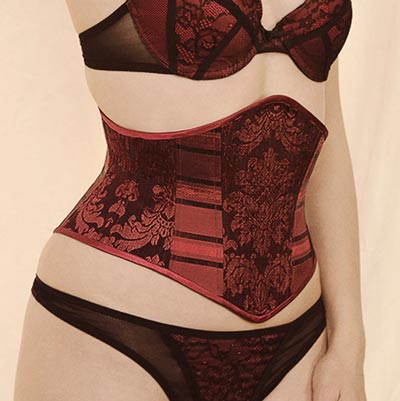
It’s important when sewing corsets to use bias binding on your corset edges both top and bottom because, as we discussed in the last post, the stretch properties of fabric cut on the bias allows it to go round the undulating curved edges of your corset without puckering up or leaving unsightly wrinkles.
When you’re learning how to make a corset, it’s a good idea to learn how to check that the binding you have is cut on the bias. You can do this by having a close look at the fabric it’s made of to see which way the grain runs. If it’s clear that the grain is running diagonally across the length of the binding, you know you have the right stuff. Also look for the joins in the binding, these will normally also be diagonal. If still in doubt lay it on a flat surface and bend the binding into a gentle curve, how does it react? If you can smooth it down with your finger and it doesn’t wrinkle at the inner edge of the curve then it’s bias binding.
Stay tuned as tomorrow I’ll be telling you how to make a corset its very own bias binding in matching fabric!