
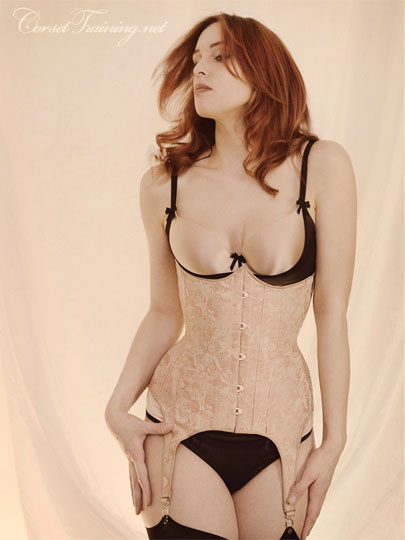
Click for bigger pic
An Introduction To Corset Making
Learning how to make a corset for the first time can be quite daunting but it’s not that different to making other garments. There are several components that are unique to the corset but putting them together requires nothing more than the average dressmakers, quilters or crafters skills. In fact if you can sew a straight(ish) line you can make a corset. (The first one is always the hardest so persevere).
I’m going to run through the main parts of a corset quickly to demystify them, then we’re going to check out some short video’s I’ve made on various aspects of making a corset, before I show you my course which really does show you everything and hold your hand as you make your first corset.
Corset Making Components
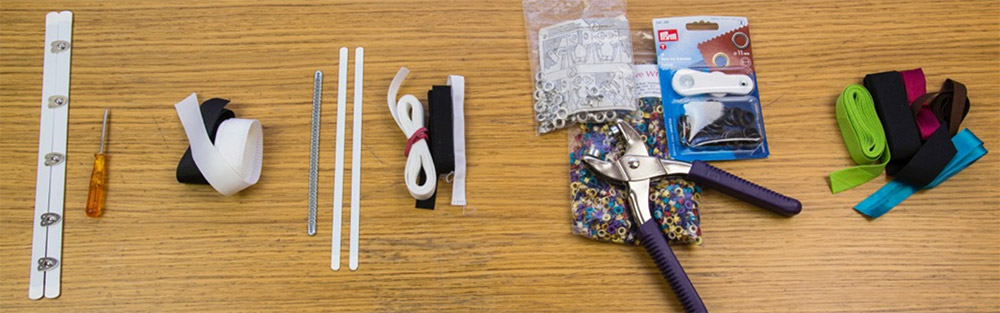
Left to Right: Front closure or ‘busk’, awl, waist tape, steel bones in spiral and flat sprung steel, bone casing, eyelets and eyelet setter, bias binding.
The fabric part requires two layers; an outer ‘fashion fabric’ layer, preferably of something thick and stretch proof but ultimately just for show, and a structural lining of coutil. Coutil is a thick cotton with a herringbone weave. It is designed not to stretch which allows for tight lacing of the corset.

Left: Ordinarily brocades & heavyweight fabrics make good outer fabrics for corsets. Right: Herringbone coutils.
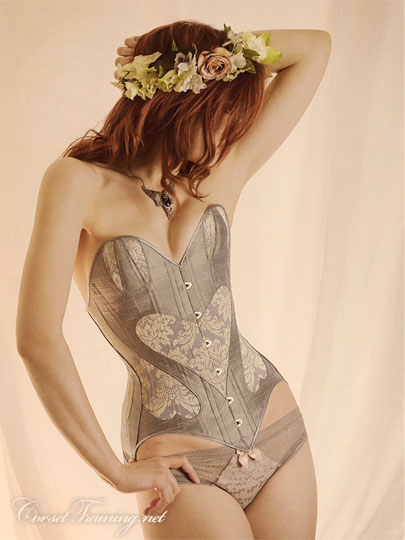
Click for bigger pic
The ‘bones‘ of the corset should be steel if it is for corset training, in fact steel is preferable for all types as plastic bones tend to get kinks in them at the waistline and are then less comfortable and more likely to break.
Eyelets (also known as grommets) at the back need to have a solid steel bone either side of them or pass through a single lacing bone (a steel bone with holes drilled into it). This is important as without a bone between the eyelets and back opening the fabric will gape in between the eyelets when the laces are pulled tight and the eyelets will be likely to pop out.
Your busk at the front is no more than a set of flat steel bones, one with loops and one with knobs. They are inserted between the two fabric layers at the front opening. Gaps are left for the loops to protrude when sewing the front seam on one side and holes are made with an awl to allow the knobs to poke through the fabric on the other side.
The How To Make A Corset Channel On YouTube
As promised here are some quick videos I’ve put together going over various techniques you’ll need when making a corset –
Eyelet Setting Tutorial
The difference between ‘sprung’ and ‘spiral’ steel bones
Sewing on Bone Casing Tutorial
Drafting Corset Patterns – How To Get Perfect Top And Bottom Edges
Make A Corset With My 2 Hour Video Course
For more detailed instructions on corset making you can checkout my video course here, it’s the ideal introduction to corset making and if you don’t like it you get your money back 😉 guaranteed. Here’s a bit more about it –